
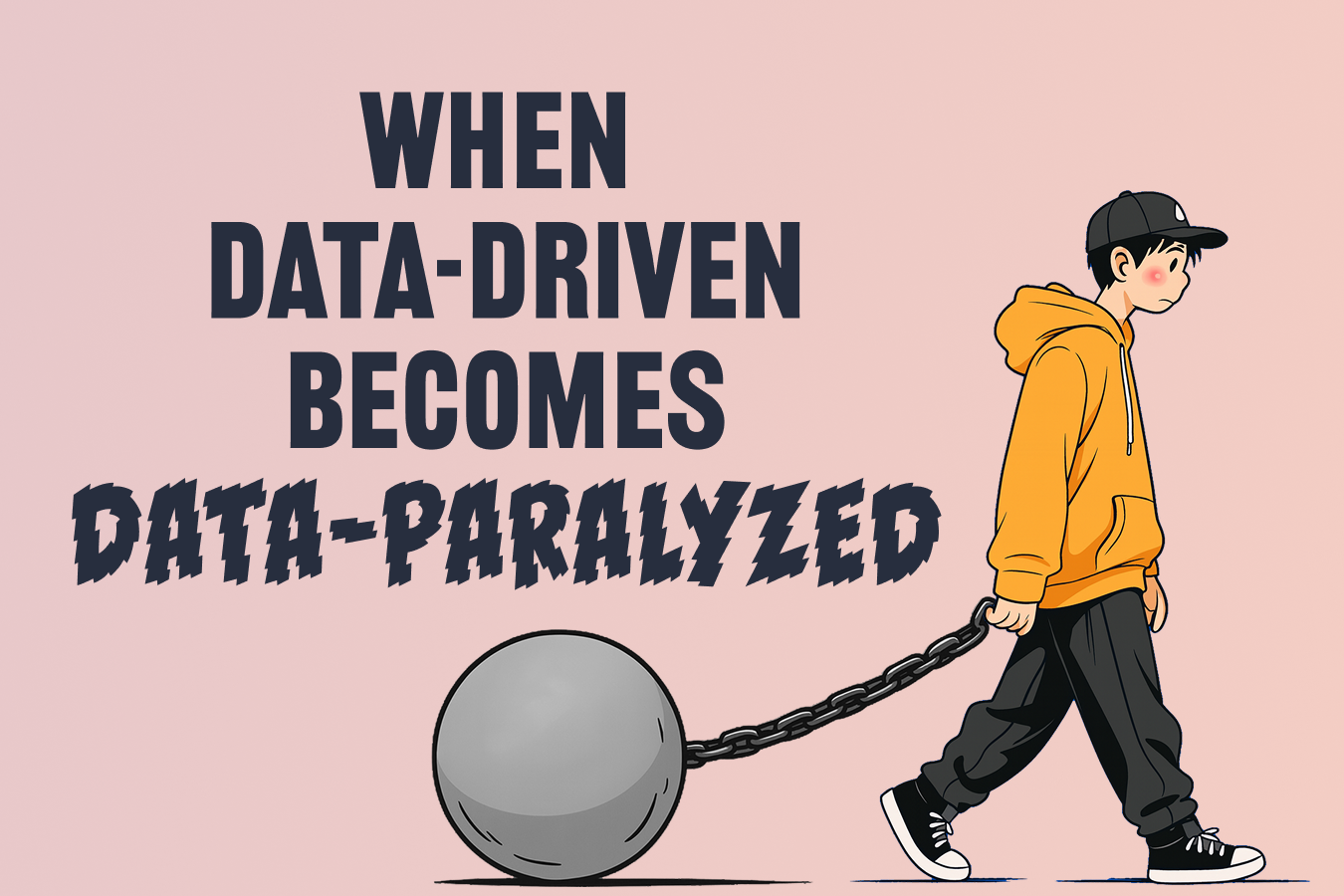
When "data-driven design" becomes "data-paralyzed design".
How over-reliance on metrics can trap teams in local optimization loops, incrementally improving mediocre experiences instead of taking the risks needed for breakthrough innovation.

Let me tell you a story that'll make you want to throw your laptop at the nearest A/B testing evangelist. (Please don't — laptops are expensive, and evangelists are surprisingly durable.)
We’ll set the scene first: Instagram's chronological feed was beloved by users, generated massive engagement, and built the foundation for a billion-user platform. Then the data scientists arrived with their beautiful charts and statistical confidence levels. They proved an algorithmic feed would boost session time by a few precious percentage points. They optimized for that metric with the precision of Swiss watchmakers.
Today Instagram feels more like a digital slot machine than a social network, and TikTok owns the cultural conversation.
This is what happens when brilliant people mistake measurement for wisdom (and yes, I've been guilty of this too). Teams become so addicted to incremental validation that they lose the ability to protect what makes their product magical. "Inconclusive results" becomes corporate code for "too risky to try." The fear of a failed A/B test overpowers the fear of becoming irrelevant.
They're spectacularly wrong about what data-driven really means.
The mathematics of optimization hamster wheels.
Reed Hastings could have spent years perfecting Netflix's DVD service. Every metric supported it: DVD margins were deliciously high while early streaming barely broke even. Customer satisfaction scores were stellar. The data was as clear as your grandmother's reading glasses.
Instead, Hastings did something that looked completely insane on paper: he deliberately cannibalized Netflix's most profitable business to chase an uncertain streaming future. (Economists call this "destroying shareholder value." Reed called it "not wanting to become Blockbuster.")
When the pricing disaster triggered massive subscriber losses and sent the stock plummeting, every business school probably used Netflix as a cautionary tale about ignoring data. Meanwhile, Reed was quietly building the foundation for streaming dominance while Blockbuster kept perfecting their late fee optimization algorithms.
This is the hidden cost of optimization loops. Teams get trapped in what behavioral economists call local maxima (imagine you're climbing a hill in thick fog and reach what feels like the top, so you stop climbing because every step goes downward — except you're actually on a tiny bump and Mount Everest is fifty yards away).
Every small improvement feels like progress while the entire landscape shifts around them. They optimize their way to the perfect version of something the market no longer wants.
Google's infamous "41 shades of blue" experiment captures this phenomenon perfectly. They tested dozens of slightly different blue hues for their ad links, with executives later claiming the optimal shade generated hundreds of millions in additional revenue (dubious math based on simplistic extrapolation from test results, the kind that would make a statistics professor weep into their correlation charts).
But that obsessive testing culture drove away Doug Bowman, Google's top designer, who quit because he couldn't work somewhere requiring statistical proof for whether a border should be 3 pixels or 4 pixels wide. So Google gained questionable ad optimization and lost the creative talent that might have prevented them from missing the entire social networking revolution.
(Sometimes I think there's a parallel universe where Google+ succeeded because they hired poets instead of statisticians. But no.)
The uncomfortable truth is that breakthrough innovation rarely shows up in your A/B tests. Revolutionary ideas typically perform worse initially because they require users to change behavior. They create confusion before they create value. They fail traditional metrics while succeeding at industry transformation.
When teams become paralyzed by the need for immediate positive data, they systematically eliminate the very ideas that could catapult them ahead of competitors. It's like using a microscope to navigate highway traffic — incredible precision applied to the wrong problem entirely.
How brilliant people follow excellent data off cliffs.
The most dangerous trap isn't bad data. It's excellent data about completely the wrong things. (This is where I remind you that correlation doesn't imply causation, but causation definitely doesn't guarantee business success either.)
BlackBerry had sophisticated user research in the mobile industry. Their enterprise customers genuinely loved physical keyboards, exceptional battery life, and military-grade security features. Every survey, every focus group, every usage study validated continued investment in these areas. BlackBerry's leadership looked at this beautiful data and declared "the most exciting mobile trend is full QWERTY keyboards."
Meanwhile, three thousand miles away, Steve Jobs was betting Apple's future on the radical idea that people would trade typing efficiency for a computer in their pocket. No focus groups supported this decision. No user research validated touchscreen keyboards. Jobs was essentially saying, "I think humans want something they don't know they want yet."
BlackBerry optimized for their existing customers while Apple re-imagined what a phone could become. (Spoiler alert: one approach worked slightly better than the other.)
This creates what I call "the tyranny of current users" — a systematic bias that skews data toward people who already chose your product, not the vastly larger population who might choose something completely different. It's like asking passengers on the Titanic about deck chair preferences while icebergs loom on the horizon.
Numbers-driven organizations develop three predictable blind spots:
The statistical significance straitjacket. Requiring near-perfect confidence for every change eliminates ambiguous experiments. Novel features often show mixed initial results because they're solving problems users don't yet know they have. It's like demanding proof that people will love pizza before inventing cheese.
The quarterly pressure cooker. Public company dynamics create incentive structures that reward hitting short-term metrics over long-term positioning. Delivering modest improvements becomes infinitely safer than risking bold bets that might hurt this quarter's numbers. (Wall Street apparently hasn't figured out that companies need a future to generate future earnings.)
The existing customer echo chamber. Your current users will enthusiastically tell you how to improve what they already chose. They're much less helpful at predicting what different people might want from a completely different approach. It's the difference between asking Ford customers about carriage improvements versus asking them if they'd like a horseless carriage.
Kodak provides a fascinatingly complex cautionary tale. They actually did try to disrupt themselves, investing heavily in digital cameras throughout the 1990s. But their strategic bet was anchored to data showing people would continue printing photos. They assumed digital would just change the capture method, not eliminate physical photos entirely. Kodak made the bold move into digital but missed the deeper insight that social media and internet sharing would obliterate printing altogether.
Even visionary companies can fall into data traps when they optimize for one disruption while missing a bigger paradigm shift.
This data paralysis manifests in measurable business outcomes that should terrify any executive with a functioning amygdala. Companies recognized as innovation leaders outperform the broader market by substantial margins annually. More dramatically, the average tenure of major companies has collapsed from multiple decades to under two decades today, with the vast majority of current leaders projected to be replaced within years.
Companies that stick to incremental optimization are literally optimizing themselves out of existence. It's the corporate equivalent of rearranging deck chairs on the Titanic, except the ship is also on fire and somehow the deck chairs are making it worse.
The magnificent lunatics who bet against their own spreadsheets.
OK, let’s flip the script and dive in to some gloriously irrational decisions that worked spectacularly well:
Netflix chose growth over defensiveness.
When Netflix launched streaming, every financial indicator screamed "Are you completely insane?" DVDs generated beautiful margins while streaming barely broke even. Content licensing costs were exploding past massive annual amounts. The initial catalog was so pathetic that even Netflix executives probably kept their Blockbuster accounts as backup.
But Hastings wasn't ignoring data — he was prioritizing strategic insight over quarterly metrics. (There's a crucial difference, though most MBAs miss it entirely.) He predicted that internet delivery would eventually replace physical media, regardless of current economics. His famous decision to exclude DVD executives from streaming strategy meetings wasn't anti-analytical; it was anti-letting current profitability blind them to future positioning.
The short-term cost was absolutely brutal. The pricing split triggered customer riots that would have impressed French revolutionaries. Revenue dipped significantly as streaming cannibalized higher-margin DVD sales. Wall Street punished the stock with the enthusiasm of medieval inquisitors.
But Netflix's willingness to sacrifice short-term comfort for long-term competitive advantage paid off in ways that make venture capitalists weep with joy. They achieved first-mover advantage in streaming while former rivals like Blockbuster experienced what economists politely call "creative destruction" and everyone else calls "bankruptcy."
Today's market cap exceeding massive valuations came from choosing strategic vision over quarterly optimization. (Sometimes being right early is indistinguishable from being crazy temporarily.)
Apple built the future instead of focus groups.
Steve Jobs famously avoided market research with the dedication of a vampire avoiding garlic. His philosophy was elegantly simple: "Customers don't know what they want until we show them." This wasn't anti-intellectual — it was recognition that breakthrough innovation requires leap-of-faith bets that data can't validate in advance.
The iPhone decision epitomizes this approach beautifully. Apple's iPod generated nearly half of company revenue. Launching a phone that included iPod functionality risked cannibalizing their most successful product. Early user research suggested touchscreen keyboards were inferior to BlackBerry's physical keys. (Remember physical keyboards? They were like touchscreens, but with actual buttons. Revolutionary technology.)
Jobs proceeded anyway, driven by the insight that "the device that will kill the iPod is the phone," combined with his determination that Apple should be the one doing the killing. His philosophy captured the essence of strategic innovation:
"If we don't cannibalize ourselves, someone else will."
The cannibalization absolutely occurred. iPod sales peaked and declined steadily as iPhone adoption grew. But this self-disruption created an entirely new ecosystem that generated trillion-dollar value and established Apple as the world's most valuable company.
(Side note: Jobs had a pattern of this behavior. He killed the floppy drive when customers still used floppies. He eliminated physical keyboards when everyone insisted they were essential. He had an almost supernatural ability to see around corners that data couldn't illuminate. Whether this was genius or luck is a debate best left to business school case studies and bar arguments.)
Tesla bet the entire company on vision.
When Tesla announced the Model 3, automotive industry wisdom suggested Elon Musk had finally lost his mind entirely. (To be fair, this wasn't their first hypothesis.) Traditional automakers struggled with low-margin vehicles. Tesla hadn't achieved consistent profitability even on their luxury models. Their existing customers weren't demanding a cheaper option.
Musk proceeded with what he explicitly called a "bet-the-company" project because it aligned with Tesla's mission to accelerate sustainable transport adoption. This wasn't achievable selling exclusively to wealthy early adopters who treated Teslas like expensive jewelry.
The transition nearly destroyed the company in ways that would make bankruptcy lawyers salivate. Tesla experienced what Musk called "production hell" — a period so challenging that the company came within weeks of death. The Model 3 cannibalized higher-margin sales while generating massive manufacturing costs that made accountants weep.
But the strategic gamble paid off in spectacular fashion. The Model 3 became the best-selling electric vehicle globally, giving Tesla multi-year leads in battery technology, software integration, and mass-market positioning. The scale economics eventually generated industry-leading margins while traditional competitors scrambled to catch up like confused tourists following the wrong GPS directions.
Adobe traded analog dollars for digital dimes.
Adobe's Creative Suite software generated substantial one-time revenue from expensive purchases that made quarterly earnings calls sound like victory celebrations. Moving to monthly subscriptions meant accepting a predicted massive revenue shortfall in year one — the kind of self-inflicted wound that usually results in CEO resignations and investor lawsuits.
Customer backlash was immediate and volcanic. Tens of thousands of users signed petitions against the change with the passion typically reserved for political protests and sports controversies.
But CFO Mark Garrett had prepared stakeholders for what he brilliantly called a "valley of death" during the transition period. Adobe consciously ignored short-term financial signals in favor of strategic positioning around recurring revenue and cloud integration. (Sometimes the best strategy looks like the worst strategy until it suddenly looks like genius.)
The self-disruption transformed Adobe into a software powerhouse with predictable recurring revenue that commands premium market valuations. By cannibalizing their own profitable model, they avoided being disrupted by cloud-native competitors who would have eventually eaten their lunch, dinner, and probably breakfast too.
The pattern across all these cases is beautifully consistent: Strategic vision trumped tactical data when breakthrough positioning was absolutely required.
These companies didn't ignore data entirely — that would have been genuinely stupid. Instead, they used metrics to optimize execution while refusing to let current performance constrain strategic direction. They recognized that truly transformative moves often look wrong on spreadsheets until they succeed magnificently.
(And then everyone pretends they saw it coming all along. But that's a different article about hindsight bias and corporate revisionist history.)
Dealing with the commercial team reality check.
Now, let's address the elephant in the conference room. (Actually, it's more like a herd of elephants, but let's start with one.)
The biggest obstacle to strategic innovation isn't technology limitations or customer resistance — it's your own sales team asking, with completely reasonable logic, "Will this help me close deals this quarter?"
This tension is as real as compound interest and twice as unavoidable. Sales teams live in quarterly cycles while breakthrough products require longer horizons that make geological timescales look rapid. When commercial teams encounter a radical new feature, they immediately push for safe incremental improvements that prospects explicitly request. It's entirely rational behavior that systematically eliminates breakthrough thinking.
(It's like asking a sprinter to train for a marathon while timing them every hundred meters. The incentives create the behavior, and the behavior creates the outcomes.)
Adobe's Creative Cloud transition shows how to navigate this organizational challenge with something approaching elegance. When they announced the subscription shift, the sales organization revolted with the enthusiasm of French peasants discovering tax increases. Account managers couldn't count big license deals toward quarterly targets anymore. Customers were furious about ongoing payments. Every commercial metric screamed "retreat immediately."
Mark Garrett's solution was genuinely elegant: he reframed what "success" meant during the transition period. Instead of quarterly revenue, sales teams were measured on subscription adoption and customer lifetime value. He gave the organization explicit permission to sacrifice this year's numbers for next decade's positioning.
The breakthrough insight here is beautifully simple: commercial teams aren't inherently anti-innovation. They're responding to incentive structures that punish them for supporting uncertain projects. Change the incentives, and you change the behavior.
Ring-fence innovation projects from quarterly pressure. Give commercial teams compelling narratives about breakthrough projects that don't depend on immediate revenue. Build coalitions with forward-looking sales managers who understand strategic positioning and can translate vision into language that resonates with quota-carrying colleagues.
The alternative is letting quarterly revenue pressure optimize away your competitive future, which is roughly equivalent to eating your seed corn because you're hungry today.
Building organizations that thrive on strategic risk.
At this point in my articles, I'm supposed to give you a framework with acronyms and consulting-friendly bullet points. Instead, let me share what actually works when you're trying to balance the need for data with the courage to ignore it.
(And yes, this is paradoxical. Breakthrough innovation is fundamentally about managing paradoxes, not resolving them.)
The solution isn't abandoning data — that would be like performing surgery blindfolded because you're tired of looking at X-rays. The trick is recognizing when to stop testing and start building based on conviction rather than certainty.
Successful organizations develop what Amazon elegantly calls being "stubborn on vision, flexible on details." They use data to refine tactics while protecting strategic bets from death by a thousand statistical cuts.
This requires conscious organizational design choices that most companies find deeply uncomfortable:
Separate optimization from innovation completely. Run two parallel tracks: one focused on improving current performance through rigorous testing, another exploring new possibilities through vision-driven experimentation. Don't let the same decision framework govern both, because they're solving fundamentally different problems.
Redefine success metrics for breakthrough projects. Instead of demanding immediate positive ROI (which is like demanding that seeds show profit before they sprout), measure learning velocity, capability building, and market positioning. Netflix didn't measure streaming success by quarterly profit but by subscriber growth and content library expansion.
Create explicit failure tolerance for strategic bets. Amazon's Jeff Bezos famously expected "multi-billion-dollar failures" and didn't penalize teams for intelligent risks that didn't pay off. The Fire Phone flopped spectacularly, but involved executives weren't publicly executed — they were reassigned to other important projects, signaling that failure was a learning experience rather than a career death sentence.
Institutionalize contrarian thinking. Designate specific roles or teams responsible for challenging conventional wisdom. Give them explicit license to propose ideas that might fail traditional metrics but could transform competitive positioning. (Someone needs to be the organizational equivalent of the kid pointing out that the emperor has no clothes.)
Microsoft's transformation under Satya Nadella exemplifies these principles beautifully. When Nadella became CEO, Microsoft was trapped optimizing Windows and Office while mobile and cloud computing reshaped the industry around them. The data showed those products were still profitable and growing incrementally — the kind of data that lulls companies into strategic complacency.
Nadella's team made several vision-driven decisions that contradicted short-term metrics with the confidence of people who understood the difference between tactics and strategy. They released Office on iPad despite potentially cannibalizing Windows tablet sales. They prioritized Azure cloud development even though it meant lower Windows Server revenue. They shifted from one-time licenses to subscriptions, accepting temporary revenue declines that made quarterly calls awkward.
The cultural transformation was equally important. Nadella explicitly told employees to "rediscover the soul of innovation" and not fear failing — radical advice in a culture that had become risk-averse through years of optimization thinking.
The result speaks louder than any consulting framework: Microsoft's market cap grew from hundreds of billions to over two trillion, largely on the strength of cloud businesses that required ignoring traditional metrics entirely.
The key insight is elegantly simple: data should inform decisions, not make them. Human judgment about market direction, customer needs, and competitive positioning remains irreplaceable for breakthrough innovation. (Artificial intelligence might change this eventually, but for now, we're still the pattern-recognition champions of the known universe.)
Less analysis, more audacity: Your escape plan from data prison.
Let me give you four things you can implement immediately, because frameworks without action items are just intellectual entertainment. (And we have Netflix for that.)
Implement the 70-20-10 innovation portfolio tomorrow. Allocate most resources to core optimization, some to adjacent improvements, and a meaningful portion to transformational bets. Protect that transformational allocation from quarterly performance reviews with the dedication of a parent protecting their child's college fund. This small percentage often generates the majority of long-term enterprise value, though you won't see it in next quarter's numbers.
Create explicit "vision override" authority for breakthrough projects. Designate specific leaders who can greenlight strategic experiments that fail conventional ROI screens. Make this authority explicit and public so teams know when to present data-driven business cases versus vision-driven strategic arguments. (Without this, every bold idea gets filtered through optimization thinking by default.)
Separate metrics for optimization versus exploration completely. Use conversion rates and engagement metrics for improving existing features. Use learning velocity and market positioning indicators for breakthrough projects. Don't let the same measurement frameworks strangle fundamentally different types of innovation — it's like using a ruler to measure temperature.
Reward intelligent failures alongside successes systematically. Institute formal recognition for well-reasoned attempts that don't work out. Without failure tolerance, teams will only propose safe incremental changes that optimize you into irrelevance faster than you can say "statistical significance."
The companies that will dominate the next decade won't be the ones with the most sophisticated optimization engines. They'll be the ones brave enough to ignore their current data when vision demands a different direction.
Your competitors are already making this choice between safe optimization and bold innovation. The question isn't whether you should take strategic risks — it's whether you'll take them before or after your competitors do.
"Your competitors are already making this choice. The question is which side of it you'll be on."
(And if you're still not convinced, remember that every major breakthrough in history looked like terrible data until it suddenly looked like genius. The trick is being right early, which requires ignoring the data that says you're wrong.)
