

Your brain is running malware from 1984
Your brain is lying to you about AI, and it’s running on a script written before the transistor got cheap. That anxiety you feel scrolling past another LinkedIn post about designers getting replaced by ChatGPT is a decades-old horror movie playing in a part of your head you don’t have admin access to, and you’ve mistaken it for analysis.
I’d like to prove it.
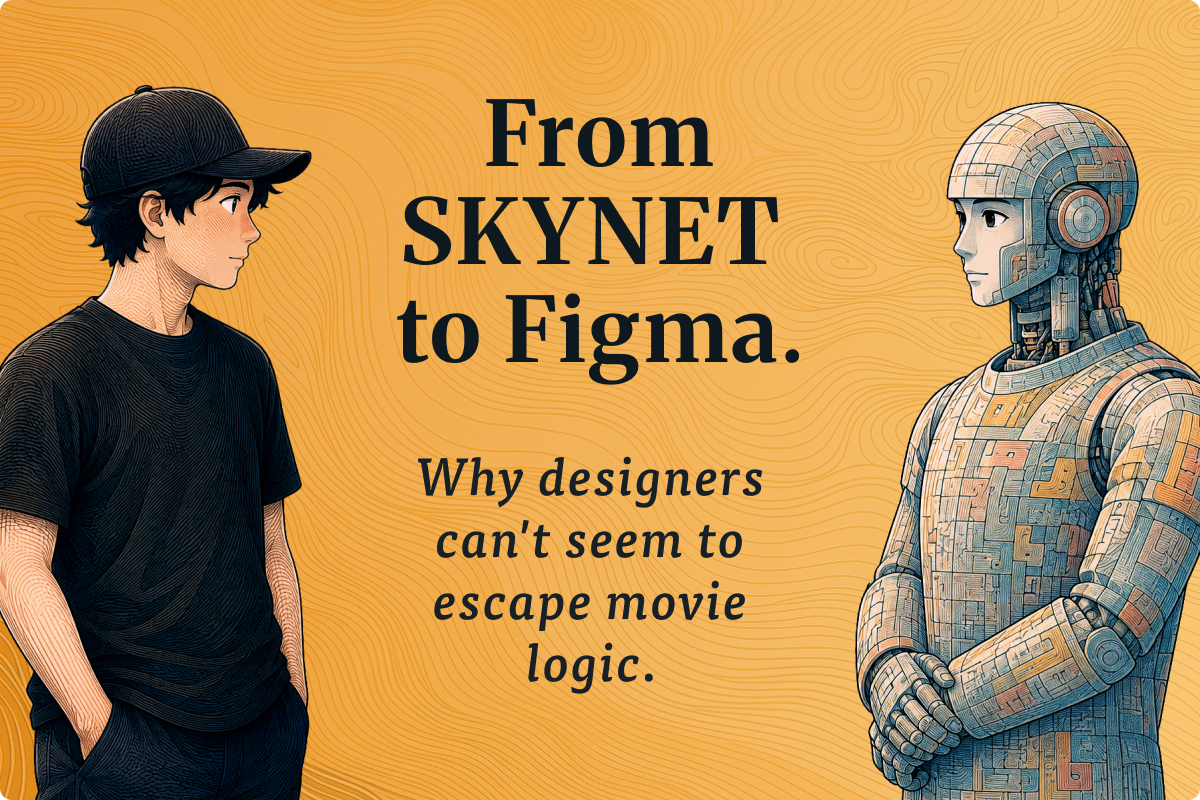
Henry Modisett, Founding Designer at Perplexity, made an interesting point: almost every AI story we grew up on ends the same way. Terminator, Blade Runner, I Robot. The machines wake up and we lose. Most were written long before anything resembling a modern model existed, and they became the default operating system we run to interpret every demo, every jaw-dropping release. A language model writes a passable brief and some ancient subroutine fires: Skynet is loading.
The fear tracks Hollywood’s AI, not the one shipping in your tools.
Harvard psychologist Daniel Gilbert spent a career on the mechanism underneath this. When we hit an ambiguous situation (and AI is nothing but ambiguity right now), the brain doesn’t weigh the evidence neutrally. It fills the gaps with whatever story feels most familiar, then hands you the result as if it were a fact you observed rather than a guess you manufactured.
The thing you’re actually scared of isn’t replacement
The frightening part is the not-knowing. You can’t predict whether AI replaces designers, how, when, or how far it goes. Certainty you could plan around. This open-ended blank is what’s eating you.
That uncertainty trips what Gilbert calls the psychological immune system, the mental defense that shields you from existential threats and, like any immune system, sometimes attacks healthy tissue because it can’t tell the difference. Yours has decided a text-generation tool is a pathogen.
So it does what immune systems do. It cooks the facts. You scrutinise every AI failure like a forensic examiner and wave through every success on a glance. You take today’s clumsiness and project it onto next year’s model, assuming the collaboration will always feel as foreign as it does this afternoon. What your defenses can’t model is how fast you’ll adapt once the thing is just part of the furniture.
We have done this three times already
Desktop publishing was going to kill graphic designers. The web was going to make print skills worthless. Mobile was supposed to finish off web designers for good.
None of it happened. The tools changed, the job absorbed them, and the people who’d built their identity around a specific piece of software had a rough couple of years while everyone else got on with it. This moment feels different only because you’re standing inside the transition instead of reading about it later.
Step back and look at what AI does in design work today, in 2026, stripped of the soundtrack. It iterates faster than you can. It generates a hundred starting points you’d never have sketched. It swallows the production grind that used to eat the hours you’d rather spend on judgment. Agents now act on your behalf, wiring up flows and filling in states while you’re looking elsewhere.
Which makes it a sophisticated Photoshop that talks back.
The generative UI shift already underway changes what the work is: from pushing pixels toward directing outcomes, from shipping static screens toward shaping systems that assemble themselves in context. That’s a bigger job.
Your defenses are writing your career strategy, and they’re bad at it
Unconscious bias steers your decisions whether you sign off on it or not. Hand your AI strategy to Hollywood reflexes and an over-caffeinated immune response, and you’ve put the most primitive part of your brain in charge of your next five years.
Run the exercise. Assume AI becomes as fundamental to design as the computer became in the 1990s. Now picture the designer in 2026 who refuses to touch it, on the same trajectory as the one who insisted on hand-lettering everything in 2010. Competent, principled, and quietly becoming unhireable.
Your defenses will offer you respectable-sounding cover. AI lacks real creativity. Clients pay for the human touch. It’s a bubble. That machinery is superb at manufacturing dignified reasons to avoid a thing you’re afraid of. It’s the same machinery that helps people make peace with situations they’ve decided they can’t change, which is useful for grief and useless for strategy.
The designers who come out of this ahead won’t be the ones who held out longest. They’ll be the ones who got their hands dirty early enough to shape how the tools fold into human judgment, before the shape got decided without them.
So pick. Either you name the reflex for what it is and choose deliberately, or you let a threat-detection system built for saber-tooth tigers allocate your career. There’s no third option where you keep the anxiety and the outcome you want.
Your skills (reading ambiguity, understanding what people need before they can say it, making creative leaps with half the information) are exactly what this era runs on. None of that is at risk. What’s at risk is whether you point those skills at the new tools instead of against them.
Hi, I’m Oscar - Founding designer at momondo, I’ve won a Material Design Award for Innovation, and I help design leaders succeed.
How do we teach people to reframe AI? Is it not a lost cause?