

Every prototype your AI tools produce is a remix of something that already shipped. You keep blaming the model, the prompt, the iteration count. Blame your first sentence instead.
A rebellious Chinese painter-monk diagnosed this failure in the late 1600s, and a Wharton researcher confirmed it with data some three and a half centuries later. Between them, they explain why your AI-assisted work feels derivative and what to do about it.
The problem with copying old masters
Shí Tāo painted in a period when Chinese art had calcified around the “Four Wangs,” a group of painters who had turned excellence into imitation. You studied the old masters, you reproduced their strokes, you got praised for fidelity. Creativity had become draw-by-numbers with better calligraphy.
Shí Tāo watched this and called it what it was: creative death by a thousand brushstrokes.
His alternative centered on what he called the primal mark. The first stroke on the paper doesn’t just influence the painting. It shapes everything that follows. Commit to a conventional opening stroke and the painting is conventional before you’ve mixed your second ink. The rest is elaboration.
For over 300 years this stayed philosophy – then someone tested it.
Science catches up with the monk
In 2014, Justin Berg at Wharton ran four experiments with around 800 participants. He gave people different starting points for creative tasks and measured the novelty and usefulness of what they produced. The design was sharper than “do starting points matter.” He tested whether different types of starting points led to predictably different outcomes.
They did. People who started from familiar concepts produced work that was useful and predictable. People who started from purely novel concepts produced work that was original and often useless. And people who started from what Berg called “integrative” concepts, blends of familiar and new, produced ideas that scored high on both. They got the breakthrough and the utility.
The worst bit is how much the starting point locked in. Once you commit to developing an idea from a particular origin, Berg writes, “the fate of any ideas that grow from it may be largely sealed.” We agonize over final details and spend almost nothing on the opening move. That’s obsessing over the steering wheel while someone else picks the road.
You can’t iterate your way out of a bad first stroke.
Your brain is a prediction engine that never switches off
One more piece makes this click. Psychologists call it “nexting,” and your brain is doing it right now. It predicts the next word in this sentence, the next stair under your foot, the arc of a frisbee, what follows “It was a dark and stormy...” Hundreds of forecasts per second, all outside awareness. When a prediction fails, you feel a jolt and your slow, deliberate thinking wakes up to investigate. The rest of the time, prediction runs the show. It’s why you can walk without computing each step and read without sounding out letters.
Large language models are nexting machines by construction. Trained on enormous datasets to predict the next token, they are prediction engines wearing a chat interface. When you ask Figma Make, or Claude Design, to design something, it forecasts the most probable design given everything it has seen.
Two prediction engines, one human and one artificial, are now sitting down to make things together. You can guess what happens next. So can they.
The AI orthodoxy trap
AI has become the new orthodox school. Type “Create a dashboard for travel management” and you’ve asked a prediction engine to forecast what follows those words based on every travel dashboard in its training data. What comes back is the design equivalent of a Four Wangs painting: competent, recognizable, spiritually empty.
Berg’s framework names the mechanism. That prompt sets a familiar primal mark, one built from conventional ideas within the domain. His experiments show this anchors you toward usefulness at the expense of novelty. You’ll get something that works. You won’t get anything new.
The AI isn’t lazy. It’s doing its job, predicting its way through the most probable sequence of design decisions. You’ve asked for the statistical average of all travel dashboards in slightly different visual clothing.
Your own brain makes it worse. You see the first outputs, your prediction engine locks on, and now you’re collaboratively predicting your way toward the most probable solution. Human and machine reinforce each other’s pull toward the familiar. A feedback loop of two nexting engines, each confirming the other’s guesses.
No wonder everything feels derivative.
The anchor that seals your fate
Berg drew on the psychology of anchoring to explain why first moves dominate. “The initial content in the primal mark may impact novelty and usefulness disproportionately more than content added later in creative tasks,” he writes. Start from a familiar mark and “familiar schemas dominate their thinking,” crowding out whatever novel associations might have surfaced.
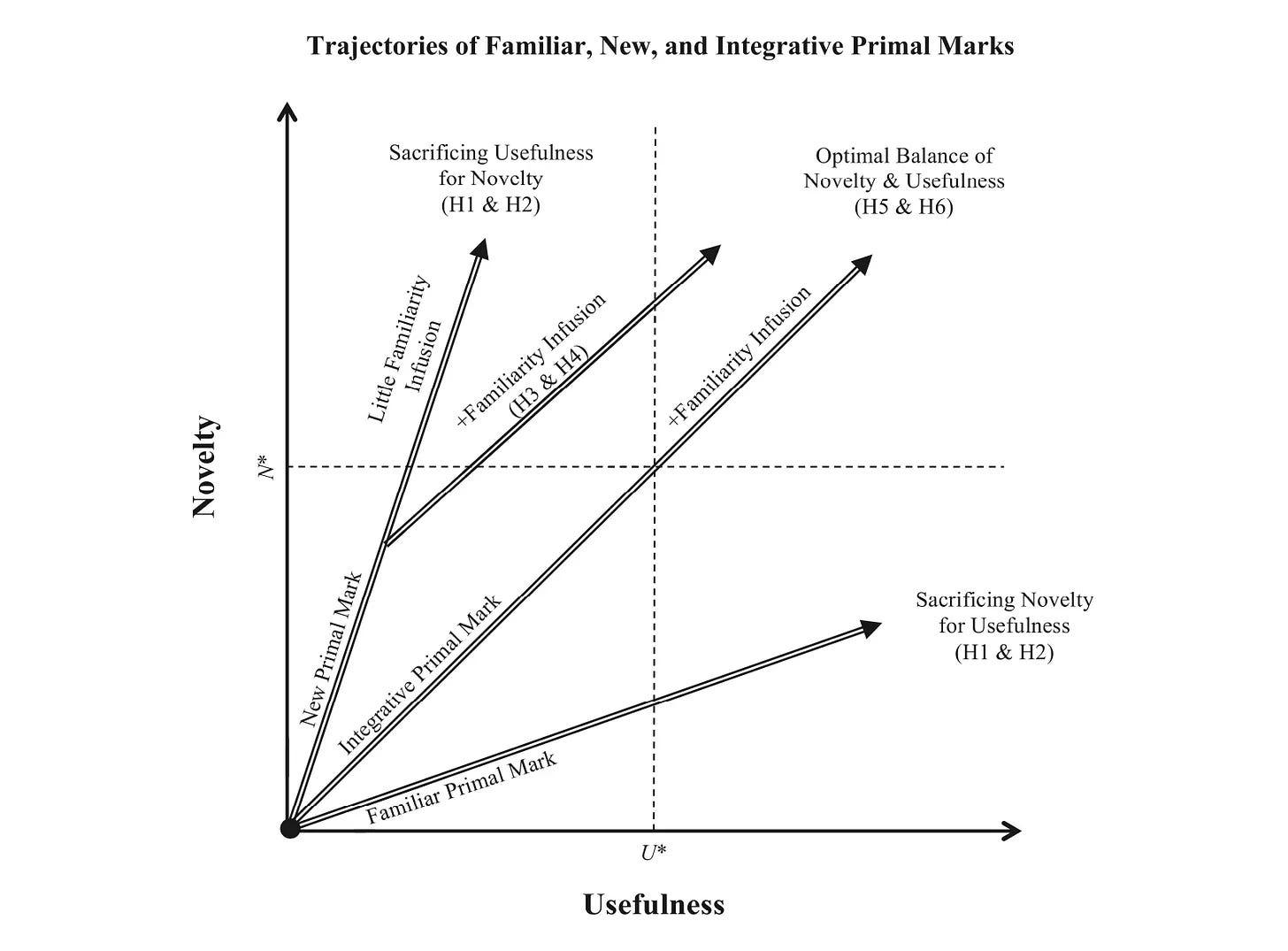
This is why those long polishing sessions with AI feel so futile. You refine and refine and never escape the gravitational pull of the first conventional idea. Berg found that novelty is “more rigidly anchored by the primal mark than usefulness.” A familiar starting point puts a ceiling on how original the result can ever be, and no amount of iteration raises it.
Shí Tāo saw this intuitively when he described painters “beclouded by things,” dragged down by “a thing’s dust.” Our dust is the sediment of every interface ever shipped, compressed into training weights and reinforced by our own predictive habits.
The method of no-method
Berg’s data points at integrative primal marks: starting points that fuse familiar and new content. Building one requires analogical thinking, searching for “higher-level, abstract parallels between two or more ideas” rather than surface similarities.
Shí Tāo called this the method of no-method, which sounds like wordplay until you apply it. It means freedom from dependence on predictive patterns. You notice when you’re predicting and you choose to break the chain.
Applied to AI, the shift looks like this. Instead of “Create a dashboard for travel management,” you open with:
“Explore how ancient migration patterns and wayfinding rituals could inform how modern travelers move through their journeys. Consider the intuitive connection nomads had with landscapes and the data streams of contemporary travel. What emerges when we honor both the need for discovery and the reality of complex logistics?”
Now you’re asking the machine to synthesize something that doesn’t exist in its training data as a settled pattern. You’ve forced it out of prediction mode. You’ve set an integrative primal mark.
And the marks pay double. Berg’s experiments showed integrative starting points beat familiar ones on novelty and beat purely novel ones on usefulness. The mechanism runs through the analogical thinking they force. Hunting for abstract parallels between distant ideas surfaces “more fundamental — and thus more novel — ways of recombining” them, while the familiar elements “enhance the clarity, meaning, legitimacy” of the result. The familiar half helps people understand the novel half. The novel half keeps the familiar half from going stale.
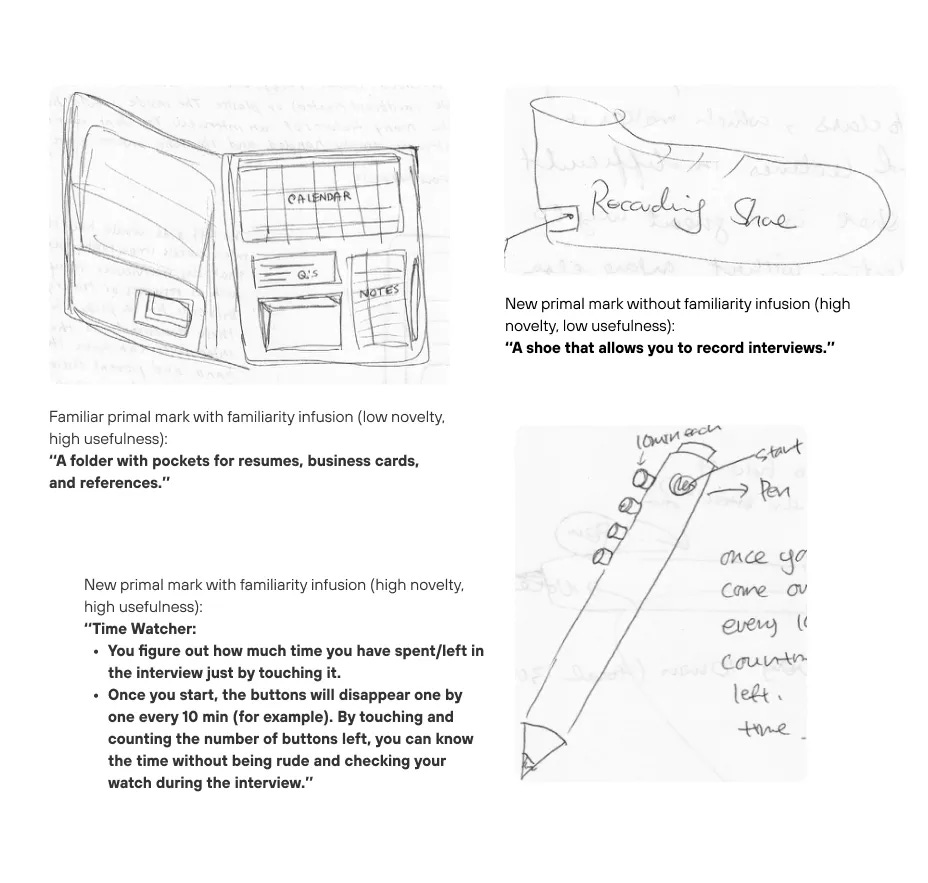
Berg’s own examples of the three primal marks in action. NGL, I want that recording shoe. 🙃
The painter moves the ink
“The painter moves the ink, the ink does not move the painter.”
— Shí Tāo
Mastery means keeping creative agency while using tools, rather than serving your tools’ tendencies. AI generates results so fast and so confidently that it’s easy to slide into outsourcing your creative decisions to statistical patterns without noticing the handover.
You see the pattern everywhere. Designers take AI wireframes as starting points and polish them. Writers take AI drafts and edit them. Strategists take AI frameworks and customize them. None of this is wrong. All of it is capped. The AI’s prediction has become your primal mark, so you’re anchored to its statistical read of the problem rather than your human read of what’s needed.
Berg’s research suggests the inversion: use AI as raw material for building integrative primal marks, never as a source of familiar ones. The ink, in other words. You hold the brush.
Three stages for breaking the chain
Stage one: interrupt your own prediction. Before you open any tool, catch your brain mid-forecast. Skip “what should the solution look like” and ask instead: what assumptions am I carrying? What would the obvious path produce? What human need sits under the stated requirements that could support a different starting point? This is strategic thinking about your primal mark before you commit to one, because once either engine starts predicting, Berg’s data says the path is hard to leave.
Stage two: prompt to force synthesis. Craft prompts that push the AI outside its probable chains. Pair domain requirements with a perspective from somewhere else entirely. Ask it to hold contradictions open rather than resolve them. Use it to question the problem definition, not just answer the problem as stated. You want a starting point that makes you slightly uncomfortable. Discomfort is evidence you’ve left familiar territory.
Stage three: watch for relapse. As you iterate, stay alert for the moment outputs start feeling “right” too fast. That ease usually means you’ve slipped back into collaborative prediction with the machine. Berg found “usefulness is more flexible than novelty”: you can make a strange idea practical later, but you can’t make a familiar idea original later. When in doubt, err toward strangeness. Surprise is your compass.
The mirror nobody ordered
One more opportunity hides in all this. An AI trained on human cultural output is a mirror reflecting the collective creative patterns of our civilization. When it generates something predictable, it’s showing you the statistical average of human work in that domain. When it generates something odd, it may be surfacing combinations that exist in the data but that nobody has consciously noticed.
Berg found people gravitate toward familiar primal marks 60 to 80 percent of the time. The bias toward the safe and conventional is in us, not just in the model. The machine lets you watch that bias operate in real time and work against it on purpose, pairing the collective intelligence baked into culture with the one capacity prediction can’t reach: imagining futures that have never appeared in any dataset.
Your next project
Pause before you open the tool. Ask whether the mark you’re about to set leads anywhere but the statistical average. Both you and the AI are prediction engines. The creative opportunity lives in breaking those chains deliberately and using the machine’s pattern-matching to reach territory neither of you would find alone.
When outputs feel right too quickly, suspect the trap. When you hit something original, trace how it happened. You’ll usually find an integrative mark at the origin, a starting point that honored both a human need and a possibility nobody had trained on yet.
Culture can keep predicting its way toward more of the same, or it can imagine something it has never seen. Your first stroke decides which one you’re contributing to.
Hi, I’m Oscar - Founding designer at momondo, I’ve won a Material Design Award for Innovation, and I help design leaders succeed.