
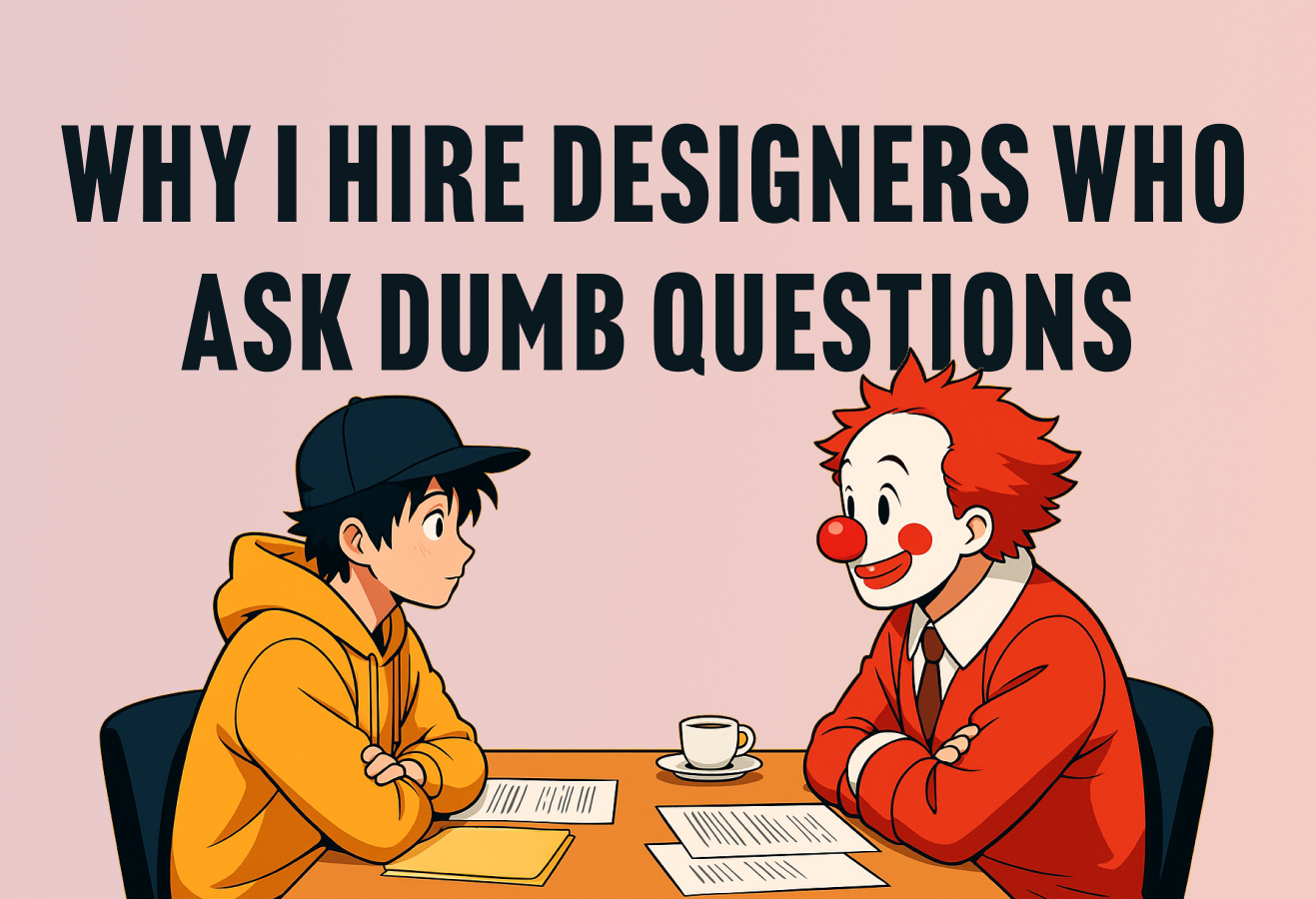
You're interviewing a designer who immediately understands your product, speaks your industry jargon fluently, and nods knowingly at your biggest challenges. Perfect fit, right? You hire them, and six months later they're producing the same solutions your team has been cycling through for years.
Meanwhile, the candidate who asked "Why would users want to do that?" gets passed over for not understanding the business. Except they were the only one actually thinking about the users.
This is the fallacy of the plug-and-play designer. We mistake familiarity for insight, domain knowledge for fresh thinking. Teams get really good at solving yesterday's problems with yesterday's solutions, while billion-dollar opportunities hide in the questions nobody thinks to ask.
Fresh eyes see what experience misses.
Sometimes the most expensive question you never ask is "Why are we trying to make a better striped soap?"
In the 1970s, Procter & Gamble spent months trying to compete with Irish Spring's green stripe. They brought in a young designer named Min Basadur who asked that seemingly obvious question and completely reframed the challenge from "How might we make a better green stripe bar?" to "How might we make a more refreshing soap?"
Three hours later, they had Coast soap. One question. Billion-dollar product.
The intern who asks "Why do we have 17 stakeholders in this meeting?" isn't being difficult. They're spotting dysfunction everyone else learned to work around. The new hire questioning why legal reviews design mocks might be uncovering a process problem adding months to every project.
"What if people could rent out their spare rooms to travelers?" — Two cash-strapped designers in San Francisco, 2007
That question sounded ridiculous to hotel industry experts. Those designers were Brian Chesky and Joe Gebbia. Their "dumb" question became Airbnb.
The difference between productive naivety and willful ignorance is curiosity versus ego. Fresh eyes ask "Help me understand the constraint here." Troublemakers ask "Why?" just to watch things burn.
We systematically train fresh perspective out of new hires. They ask "Why do we do it this way?" and get hit with "That's just how we do things here" (the six words that kill innovation, according to Steve Blank). After a few rounds, they stop asking. Often nobody remembers why the process exists in the first place.
How to spot the good question-askers.
I've got a go-to interview move that reveals everything about how someone thinks. I show candidates a polished piece of our design work — maybe our booking flow or onboarding sequence — and ask them to walk me through what they notice.
The weak candidates ask surface-level questions about visual details. "What font is this? Why did you choose this shade of orange? Do you use relative nested corner radii?" They're focused on the what and how of design decisions. (OK, that last one about corner radii is a green flag, not gonna lie.)
But the naturally curious ones? They squint at the screen. They ask follow-up questions. "This is really clean, but I'm curious about the mobile breakpoint here. How do users typically navigate between these sections?" They're not trying to flatter me. They're trying to understand the problem we were solving.
Here's where I test their intellectual humility. I'll point out a potential improvement in their portfolio work — nothing harsh, just a thoughtful observation about a different approach they could have taken.
The candidates who freeze up or immediately justify their choices are telling me everything I need to know. "Well, we couldn't do that because of technical constraints" or "The stakeholders wouldn't have gone for it." They're in defense mode, protecting their ego instead of engaging with the idea.
The ones I want to hire get visibly excited. "Oh, that's an interesting note… I never thought about approaching it that way. That could have solved the accessibility issue we ran into later." They treat feedback like a puzzle piece they've been looking for, not an attack they need to repel.
The best candidates balance respect for requirements with healthy skepticism. They prioritize understanding the real problem before solving it.
Designers who ask clarifying questions during interviews become dramatically better at stakeholder management. Picture an airline's customer experience team being told to "make the boarding process feel more premium." The person who asks "What do you mean by premium feel?" instead of nodding and guessing always produces work that matches what stakeholders actually had in mind.
Building teams that make your whole organization smarter.
Your organization will immediately try to train curiosity out of new hires. They'll ask "Why does this process exist?" and get shut down with "Because that's our process."
Your job as a leader is creating psychological safety for questioning while maintaining execution focus. It won’t always be easy.
Implementation strategies that work for me:
Explicitly tell new hires their fresh perspective is valuable. I literally say "Your job for the first 90 days is to ask dumb questions. We've gone blind to our own problems."
Pair curious newcomers with experienced designers who welcome questions, not those who get territorial about their expertise.
In team meetings, praise good questions as much as good answers. When someone asks "Wait, why are we solving this problem again?" dig in instead of rushing past it.
Protect questioners from institutional antibodies. When senior stakeholders grumble about the new person "not understanding how we work," that's usually a sign they're onto something important.
Experience tells you which questions have been asked before. Curiosity tells you which new questions haven't been asked yet. You need both on a team, but if forced to choose, I'll take the curious novice over the complacent veteran every time.
The paradox of design expertise is that the more experienced you become, the harder it gets to see your work through fresh eyes. Veteran designers have to actively fight against their accumulated assumptions and biases. Sometimes the most efficient way to maintain that beginner's perspective is to hire people who actually have it.
Curious designers transform entire organizations. Someone questions why user research happens after designs are finalized, and suddenly the whole product development process gets smarter. Someone asks "Why don't we ever talk to users who didn't end up booking?" and the entire growth strategy shifts.
"Experience tells you which questions have been asked before. Curiosity tells you which new questions haven't been asked yet."
The compound interest of intellectual curiosity.
The most dangerous phrase in design isn't "That's how we've always done it." It's "Users love this feature." The first acknowledges tradition exists. The second wraps ego in the flag of user research.
Teams that celebrate dumb questions build organizations that can adapt, learn, and spot opportunities experts miss. They create cultures where a 22-year-old intern can save months of wasted process, where a fresh hire can prevent expensive duplicate features, where someone can ask "What if users don't actually want this?" without getting fired.
The designers who ask obvious questions aren't slowing you down. They're the canaries in your coal mine, spotting expensive mistakes hiding in plain sight. They're building teams that make your whole company smarter, one beautifully naive question at a time.
When a candidate asks "Why would users want to do that?" instead of immediately nodding along with your product vision, don't pass them over for not understanding the business. Thank them for being the only person in the room actually thinking about the users.