


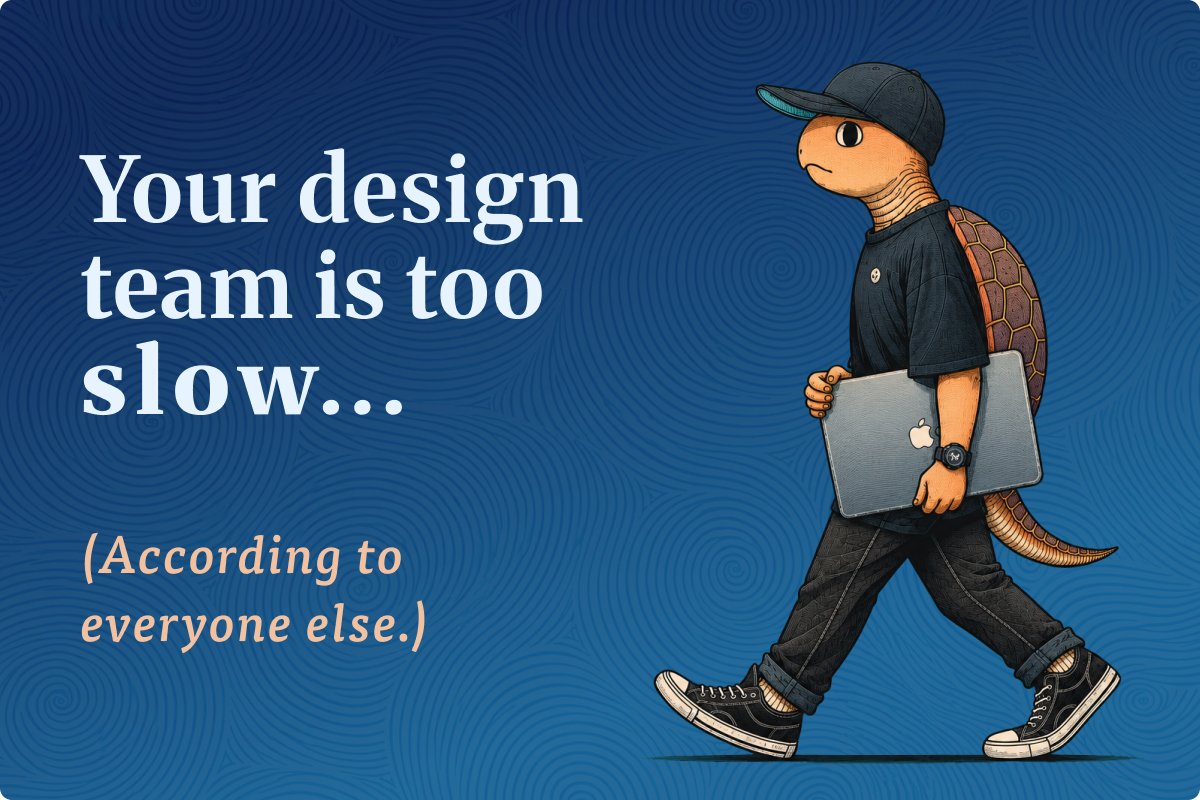
We all agree creativity can’t be rushed, that good work needs its iterations and that inspiration lands when it lands. And design managers have become the strongest defenders of that notion. So you explain why research takes three weeks, you defend your second round of iteration, you educate stakeholders about a creative process that resists deadlines, and every one of those explanations confirms the very thing you’re arguing against. The room hears that design is the part that can’t keep up.
And in a raw comparison it looks bad. Engineering ships code in hours while a designer spends two days on visual hierarchy. Product decides something in a Tuesday meeting while design goes off to “explore the problem space”, and anyone watching the calendar draws the obvious conclusion.
Agile was tuned for engineering and runs beautifully there. Tickets, story points, stand-ups, a burndown chart that meticulously shows progress and delivery. And then design work goes into that same machine, asking it to declare up front how long it will take to make the experience better, or to work out why conversion dropped, without spending too much time thinking about it. Neither of those is a story, or can be estimated effortlessly in Fibonacci series. And what comes out the other end instead measures how badly the container fits, and says nothing at all about how fast your designers work.
Companies that ship fast instead get there by pulling friction out of everything sitting around design, not by hiring “quicker” designers.
Find your bottlenecks before you defend anyone
Your first instinct as a design manager when someone calls the team slow is to protect them, and that instinct puts you in the weakest position in the room - explaining instead of diagnosing. Someone just handed you a systems problem with a people label. Take off the label before you start arguing.
Start by counting. How many engineers do we have on the product team versus how many designers. Most organizations land somewhere around six or eight engineers to a single designer, and that designer is often split across two or three initiatives while also being asked to run research, make wireframes, design the UI, write the UX copy and also keeping three different sets of stakeholders informed. Nobody is slow in that arrangement. The math just doesn’t math.
Then you look at when design actually gets invited. What often happens in tech is that requirements are already locked by commercial, the timeline is set by the PM, the architecture is agreed with tech, and somewhere after all of that someone remembers to add design to the mix. And all you’re left with now is repair work on decisions nobody made with a user in the room – and repair always takes longer than the original would have.
The final part is the scope. Monday it’s a settings page. Wednesday it needs enterprise permissions, three API integrations and could it work on my iPad too? Each of those changes fans out into a week of revisions, and when the deadline slips the slip often gets marked against design.
Buy speed with better choices
Once you’ve snapped out of your defensive mode, you can start deciding, and the first decision is where quality pays.
A small handful of design decisions carry most of the impact for actual users, so spend there and stop pretending the rest deserves equal care. A Kano diagram always comes in handy up front. Look at the core flows, the interactions people repeat daily and the moments that shape how the brand feels all earn the extra week. Internal admin screens and the edge case that fires twice a month aren’t in quite the same category.
And sometimes shipping something rough is the right call to make. UX debt behaves like technical debt, fine to borrow against and darn dangerous to forget. So while you’re shipping the fix that stops the leak, you also need to book in the thing that isn’t just a fix.
Design systems are where this really compounds. A shared system lets you build better and faster at the same time, better because people understand a consistent experience more easily and faster because everyone works from the same vocabulary. And a smart and structured approach does more for velocity than any process change, since a designer reaching for a component that already exists isn’t making a tricky decision call. But a rushed system produces components people quietly refuse to use, and then you’ve paid for the thing and kept the silos anyway.
Finally, run design sprints ahead of development rather than inside it. In a dual-track setup the discovery work happens in parallel, so by the time engineers start building, the flows and the research behind them are already sitting there. With AI prototyping setups, you can work technical feasibility and validation of your solutions right into the discovery phase without tons of dedicated engineering resources.
And so engineers stop having to wait and designers stop trying to sprint after a train that left the platform without them.
Lead the conversation
Make the work visible, because a lot of the complaint is actually about opacity. A board people can see, a slack channel where sketches turn into wireframes and then into something clickable, a monthly showcase, the format matters less than the idea that people get to watch it happen. Visibility kills most complaints and misconceptions before anyone has to answer them.
When you do push back, bring receipts. Name the project where skipping research produced a feature nobody used, or the rushed flow that cost engineering two months of rework afterwards.
Make it safe to ship something imperfect on purpose. If your designers thinks every release is a referendum on their craft, they’ll polish the backend modal to the same standard as the booking flow, and you’ll have fostered the exact slowness you’re trying not to get blamed for.
The one thing that won’t work for you, is more explaining. Every meeting you spend defending your creative process keeps everyone’s idea of slow design exactly as wrong as it was when you walked in.
Hi, I’m Oscar - Founding designer at momondo, I’ve won a Material Design Award for Innovation, and I help design leaders succeed.
🍵